Tessa
After Ever HappyTessa is the novel’s central first-person narrator, and her story turns on a difficult distinction: loving someone does not mean surrendering the right to choose a life for herself. She moves through Hardin’s self-destructive crises, her father’s death, and years of distance from Hardin without treating any single reconciliation as a cure. By the later chapters, she has made space for work, family, and an identity that is still developing; the ending presents that growth not as a clean escape from the past, but as a life built after it.
Identity and Background
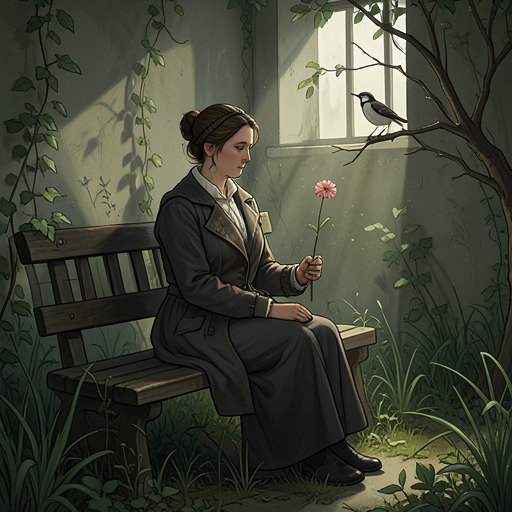
Tessa’s narration makes private perception central to the story. At the opening, she faces a man who is said to have fathered her and notices his green eyes and the line of his jaw. When he pushes back his hair, she realizes she is making the same gesture. The resemblance unsettles her physically: the room seems to spin, and she tries to sit upright on a bench as the grass appears unsteady beneath her. The scene places recognition in the body before it becomes an explanation, and shows how questions of parentage can unsettle her sense of who she is.
Her relationship with her father, Richard, becomes a more devastating test of that identity. After reading pages Hardin wrote about his own remorse, Tessa leaves the box of pages and goes to the bathroom. She catches her foot on something, then recognizes the still body as her father’s, with a needle in his arm. The discovery makes her nightmares real in a precise, irreversible way: the dead man is not Hardin, but Richard. Tessa’s loss is not only grief for a parent; it is a sudden confrontation with the consequences of addiction and the limits of what she can protect.
Love, Crisis, and Separation
Tessa repeatedly tries to reach Hardin when he retreats into pain and self-destruction. At the bar, she finds him drinking, barefoot in a dress after walking there in painful shoes. His eyes are bloodshot, liquor hangs heavily in the air, and three empty shot glasses stand before him. He drains another glass and calls for more. Her hope that he would not drink his pain away is already under strain, but she approaches him rather than turning away.
When she tells him she loves him and is not leaving, Hardin answers with a bleak literary allusion: he treats love as proof that a happy ending is impossible. Tessa recognizes the words and refuses to let the quotation settle the meaning of their relationship. Hardin calls himself too damaged for happiness and turns away. The exchange exposes a recurring mismatch: Tessa speaks toward connection, while Hardin’s shame and despair make separation sound inevitable. Her insistence on reaching him is real, but it does not make his destructive choices harmless.
The conflict sharpens after Hardin burns a house and shows no remorse. In a conversation with Kimberly, Tessa says that the crisis between Hardin and his mother, Trish, could either finish their relationship or become its saving grace; she is afraid of either outcome. She explains that Hardin wants to remain in London and send her back to Seattle, and that he withdraws whenever he is hurt. Her account is not a simple defense of him: she names his anger and recognizes that his conduct is making matters worse. The fear she confides to Kimberly is that their history gives her no reliable way to know whether another rupture will be final.
Tessa reaches Heathrow in time to leave. Kimberly hugs her goodbye, while Smith watches her in a way she cannot interpret. The departure gives physical form to the distance she has been struggling to claim. Later, after moving to New York with Landon, she and Hardin see each other casually, without either demanding that the other relocate. Their arrangement preserves connection while giving Tessa room to live apart from him. Hardin eventually makes frequent work trips to the city, and she is happy when he arrives and wants him to stay when he leaves; the unresolved pull between them remains, but it no longer dictates an immediate shared address.
Grief, Family, and Care
Tessa’s discovery of Richard’s body is followed by an experience of grief that leaves her unable to manage alone. When a familiar voice returns to comfort her, Noah lifts her from the floor and holds her; Tessa buries her head against his chest and closes her eyes. The scene gives her grief a witness and a source of physical support, rather than making resilience mean that she must endure the shock unaided.
The greenhouse is another place associated with her retreat. Noah recognizes that she has gone there and remembers that she used to come inside. His response is to leave her there and go back to the house. The brief exchange makes the greenhouse part of the history other people share with Tessa: it is a place they know she seeks, but Noah does not force his presence on her in that moment.
At the funeral, Tessa asks her mother who is paying for it. She worries that her mother cannot afford the expense and may have taken it on to prove something to people at church. Her distress is concrete as well as emotional: she does not want the black dress or high heels her mother bought, and most of all she does not want to watch her father be buried. With no living grandparents and both parents having been only children, she also sees how small the family circle around the funeral is. Her practical concern about money coexists with a wish not to participate in the ceremony at all.
Work, Independence, and Change
Tessa’s later independence develops through work rather than through a single declaration of a new identity. Her interest in wedding planning begins when Landon’s bride does not want to hire a planner despite not knowing how to organize the day. Tessa becomes involved in the preparations and discovers that she enjoys taking charge of an important event for other people. Landon helps his fiancée, staying up late with the magazines and missing class to attend repeated cake tastings. Tessa first imagines planning weddings as a hobby; then she attends bridal expos and begins planning Kimberly and Christian’s wedding.
Even after she has found a direction, Tessa keeps her job at Vance Publishing in New York City because she needs the income. She will not let Hardin pay all her bills while she works out her next step. Although she is proud of her college degree, she no longer wants to work in the field she chose at WCU. Hardin gives her a hard time because she had once been certain about that career, but Tessa understands the change as part of growing up: she did not know herself when she first made the decision. She is unwilling to treat an early choice as a lifelong obligation simply because she once felt sure.
The contrast with Landon is telling. His job as a fifth-grade teacher in a public school in Brooklyn is already lined up, while Hardin, at twenty-five, has four published books and is a New York Times bestseller. Tessa is still figuring out her path, but she no longer experiences that uncertainty as a failure or a deadline. She wants her choices to make her happy and, for the first time, puts that happiness before anyone else’s expectations. In Brooklyn, she works at a restaurant between wedding-planning jobs and classes, and shares an apartment with Hardin that he is willing to let her help pay for despite his greater income.
Later Life and Significance
Tessa’s account of Hardin’s change does not erase the damage he caused. Looking back over the previous four years, she acknowledges that he held on to his past so tightly that he broke her in the process. She also acknowledges her own imperfections, while insisting that his mistakes were massive and devastating and that he paid for them. Her respect for him is therefore neither an excuse nor a denial. Her mother, too, has gained a new respect for Hardin, although he is not her favorite person; the shift registers how much their relationship has altered over time.
Six years later, Tessa is pregnant with her second child, a boy named Auden, and planning three weddings at once from the kitchen table of a new apartment. Late pregnancy leaves her tired, swollen, and determined to finish the work, with the first wedding only a week away. Her business has begun to establish itself in New York City: inquiries fill her phone and email, and she is building her name and earning a decent income. Hardin complains that she is working too hard but knows not to press the point. The scene makes visible the consequence of her earlier willingness to take time: wedding planning is no longer a tentative hobby but a growing livelihood.
The later Tessa can love Hardin without making his past the only measure of her future. Her story does not claim that distance instantly resolves their damage, or that work removes grief. Instead, the movement from crisis and dependence toward chosen work, mutual respect, and family gives the ending its shape. After everything, Tessa and Hardin have made a life together; the final image of her relaxing beneath his hands, with love still present in her blue-gray eyes, joins that durable attachment to the years of effort it took to reach it.